
Description
Book overview
Are Demons real? Is there such thing as an Unseen World? Can a man be held captive in the realm of the spirit and not know? Is there such thing as a spirit-controlled world? Are our lives a reflection of what happens to our Spirit Being? Can we ever find answers, or understand the incomprehensible things that tie a man down?
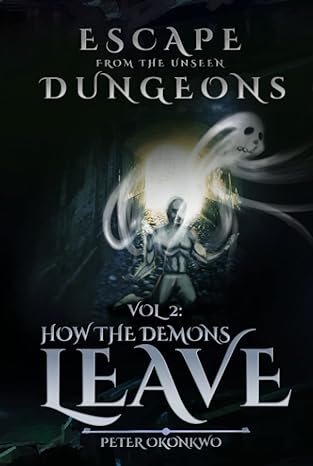
Following on from the lamentation of our captured narrator in A Cry for Mercy, HOW THE DEMONS LEAVE detailed his after-woe experience as he begins to gain insight to understand the unnatural trouble that besets his soul. This was followed by moments of realization, and the understanding of the spirituality of the world.
This spiritual book of poetry is written in three distinct volumes, A CRY FOR MERCY, HOW THE DEMONS LEAVE, and I SAW THE LIGHT with each section touching deeply into matters that address human conditions, and other divine subjects. This book can be considered as a resource for the thoughtful examination of the reality of the Spirit Realm, Demons, Spiritual Obstacles in Life, Higher and Dark Powers. It tells the story of captivity, unbeknownst bondage, spiritual slavery, enlightenment, liberation, and deliverance. You will find answers to the many incomprehensible things that tie a man down.
A very brave undertaking writing on what most would dare not take on.
The Spiritual Realm is not for the faint of heart. Okonkwo’s How the Demons Leave is book # 2 from the series.
He was a very honest writer. Not failing to shy away from many topics: Faith, Fasting and Prayer, Struggle, Redemption, and finally Deliverance.
Okonkwo delivered a very solid, uplifting, concise and deliberate work.
How the Demons Leave is a highly recommended resource guide of how one can understand what is not always clearly tangible or seen in the spiritual realm.
A very faithful and intriguing Redemption story written in poetic verse.
Helpful
Share
Report
Kevin Killiany
4.0 out of 5 stars
A rewarding personal journey with Psalms and Wisdom
Reviewed in the United States on March 7, 2023
Peter Okonkwo’s second volume of poetry in his Escape from the Unseen Dungeons series continues his introspective meditations on the roles of fate, faith, and personal responsibility in determining our journey through this life towards the next. His range of tones — sometimes lamenting, sometimes questioning, sometimes affirming, and occasionally celebrating — are evocative of both the Psalms of David and the Book of Wisdom. More then once Okonkwo made me stop and think.
The two reasons why I awarded four stars instead of five (and I would have given four-and-two-thirds if I could) may have more to do with me than Mr. Okonkwo’s work. Specifically, my years as an English teacher.
First, much, if not most, of every poem is written in blank verse — poetry without rhyme but with a structured rhythm, like a metronome or footsteps — but at unexpected moments they break into free verse and the rhythm is lost. I suspect this was intentional, that the poet’s purpose was to call attention to an important thought or moment, or it could be that what he needed to say demanded the change. Whatever the reason, I found those moments jarring (even though I enjoyed the poem as a whole).
Second, there were editorial errors — mechanical things like subject/verb agreement and misused words. Details perhaps only a recovering English teacher would notice, but ones which the line editor should have caught nonetheless.
Those minor quibbles aside, I think Peter Okonkwo was quite brave to invite us along on his journey of spiritual exploration and personal growth. I highly recommend his poetry to anyone considering such a journey and to those who are already on the path.
Top reviews from other countries
Natasha
3.0 out of 5 starsVerified Purchase
Powerful, imaginative work. An epic and emotional spiritual journey.
Reviewed in the United Kingdom on May 17, 2023
How the demons leave is a sequel to ‘A Cry for Mercy’. Once again, the writers takes us on an epic emotional and spiritual journey. When I read ‘A Cry for Mercy’, I saw two distinct narrative voices, one who struggled with yearning for earthly success and the other who struggled with the lusts of the flesh. It felt to me like they talked to each other through this work of poetry. Whether intended as two souls or one caught in a battle with itself, it was an eye-opening exploration into dark places. In ‘How the Demons Leave’ these voices come together in a spiritual battle. The language is once again passionate and powerful, yet I felt it lacked the poetic form of the previous work. Both written in free verse, whilst ‘A Cry for Mercy’ could have had more poetic finesse, it still read like poetry. This work, for the most part, does not read like poetry at all but like imaginative prose. I couldn’t identify purpose behind the line breaks and no discernible punctuation, rhythm or rhyme is used. As I read it, each line led into the other with no pause. Perhaps it would sound different when read aloud. Perhaps I missed something significant. But despite the subject matter of demons, it also lacked the nuances and symbolism of the previous work. I think the writer would have been better served writing this account as a short story, or if determined to write poetry, taking more time over the construction of his language and verse. As regards the content, there is a lot here to feast on and encourage. The author describes graphically coming face to face with demons in the spiritual realm, and the need to break free from these demons in a very real way. He justifies the reality of the spiritual realm, challenging us to step outside of what we can physically see and look beyond. The power to defeat the demons comes in the first instance through graphic spiritual struggle and in the second, through prayer. Through turning to God, the ‘plans of his foes’ are exposed, he learns to truly wrestle, and the secret things are made open. The fetters that bind him, that we saw so harrowingly described in the first book, are loosened. However, the prosperity gospel remains. ‘I command wealth and favor to come my way. I command success to come my way, and it obeys. I command all that I want for myself and they come through.’ Whilst soaking himself in the saving blood of Jesus, he remains preoccupied with ‘favor, prosperity and fame,’ desiring ’the power that will make me distinctive amidst my peers.’ Spiritual strength comes through prayer, certainly, but I remain deeply concerned for the narrator regarding whose glory he is seeking. Nowhere in the scripture are we promised fame and material blessing. In fact, the opposite is often true. The Lord uses hardship to sanctify us and make us more like Christ. Certainly there is power in the name of Jesus to break every chain (and freedom in Christ carries many blessings), yet the desired result should be the growth of the Kingdom of God. It seems the hardship has been realised, but not its purpose. I hope this is something that will be redeemed in the final volume.


 Baylitreading
Nice info
LikeLike
Thanks Sir
LikeLiked by 1 person